February 25, 2010

Aaron Hicks Interview

Aaron Hicks is a name most Twins fans are becoming familiar with. Not only is he considered the Twins top prospect by respected scouting establishments like Baseball America, ESPN (Scouts.inc) and Baseball Prospects (among others), he's also considered one of the best prospects in all of baseball, ranked as high as no. 19 in ESPN (Scouts.inc) and Baseball America's Top 100 Prospect lists.

Selected by the Twins with the 14th overall pick in the 2008 draft, Hicks wasted no time making a big impact, hitting .318/.409/.491 in 45 games with the Gulf Coast League Twins. In 2009, Hicks began the season in Extended Spring Training, but Beloit's offense needed a spark and instead of sticking with the status quo and going to Elizabethton, Hicks was sent to Beloit. He didn't put up ungodly numbers, but his plate discipline and defensive prowess were outstanding. He hit .251/.353/.382 in 67 games with the Snappers, but at 19-years-old, those numbers are great. After the season, Baseball America named him the top prospect of the Midwest League.

Despite his age, scouts have compared Hicks to the likes of Torii Hunter, Adam Jones and Darryl Strawberry (among others), all of whom seem to be very realistic examples. He's a great athlete and his bat is really the only question right now, but despite it being raw, he has hit well and should continue to improve with age. So without further ado, here's Aaron Hicks.


Josh's Thoughts: You have widely been considered the Twins Top Prospect, do you feel any added pressure due to this? Do you generally pay attention to prospect rankings? And how do you deal with pressure?
Aaron Hicks: You know, I actually don't worry about rankings. I leave that to my parents who like to see where I'm at in the rankings. I'm more focused on getting to the big leagues and staying there for a long time. I also want to be known to the fans as a guy that never gave up and left everything I had on the field. As for the pressure, I don't worry about that I'm here to play ball the best that I can.

Josh's Thoughts: Tell us a little about being drafted. How did it feel? Before you were drafted, what team did you have the most contact with? Did you have a lot of contact with the Twins? Were you surprised to be taken by the Twins? Did you expect to go sooner or later?
Aaron Hicks: Being drafted was a great feeling and I loved being at the draft. I was contacted a lot by the Dodgers probably because I'm from L.A. (which is obviously close to the big league team). I was liking my chances of going to the Twins but I thought maybe the Cardinals at 13 might draft me but I was told that I was high with the dodgers at 15.

Josh's Thoughts: Prior to the draft, you were also considered one of the top prep-pitchers in the nation.What position did you prefer (pitcher/outfielder)? Was it hard to pass up the scholarship to USC?
Aaron Hicks: I liked pitching because I had to do what was best for my team at that point, but I'm truly a position player; that's my passion. But passing up going to USC was hard. I liked the coaches and how they approached me. They kept me wanting to go there.

Josh's Thoughts: What has been your favorite minor league stadium to play at?
Aaron Hicks: I like the stadium where the (Reds minor league affiliates) Dayton Dragons play.

Josh's Thoughts: What has been your greatest baseball moment?
Aaron Hicks: My greatest (minor league) moment was hitting a grand slam at home in Beloit. But my best moment in High School was being ranked the #1 National Championship high school team and winning C.I.F. Championship at Dodger Stadium.

Josh's Thoughts: What has been the most difficult part about professional baseball? Best part?
Aaron Hicks: I would say traveling and having thousands of fans watching your games.

Josh's Thoughts: What is something people might be shocked to know about you?
Aaron Hicks: I started playing baseball when I was 13.

Josh's Thoughts: Do you have a nickname?
Aaron Hicks: Guys from back home call me "Mr. Superstar" because I ended up being good at every sport I tried like basketball, football, golf, tennis, and soccer.

Josh's Thoughts: If you weren't playing professional baseball, what do you think you'd be doing?
Aaron Hicks: Playing golf.

Josh's Thoughts: What do you like to do in your free time?
Aaron Hicks: Haha, play golf.

Josh's Thoughts: Who were some of your favorite players growing up?
Aaron Hicks: Ken Griffey Jr. and Tiger Woods. I know he's not a player, but he's a great athlete.

Josh's Thoughts: Who has had the biggest influence on your career?
Aaron Hicks: My parents, they always want what's best for me.

Josh's Thoughts: What kind of music do you listen to?
Aaron Hicks: I listen to all kinds of music.

Josh's Thoughts: Did you play any other sports in high school? How good were you?
Aaron Hicks: I played basketball in High School through my sophomore year. I played forward and was pretty good dunking as a freshman.

Josh's Thoughts: Do you have a daily routine during the season?
Aaron Hicks: Really, I just take front toss before the game.

Josh's Thoughts: If you were commissioner for a day, what change would you make in baseball?
Aaron Hicks: Personally, I have no idea what to do if I was in that situation.

Josh's Thoughts: What do you do in the off-season? When do you start preparing for the next season? Have any idea of where you might start the year?
Aaron Hicks: In the off-season, I work out everyday. This past off season, I've been mainly working on running. I've been running since the 4th of November and started hitting on a regular basis on the 1st of December. I have no idea where I'll start, but hopefully it's Fort Myers.

Josh's Thoughts: What are your thoughts on TwinsFest? Do you enjoy signing autographs?
Aaron Hicks: I loved TwinsFest. It was fun meeting the fans and the atmosphere was great. I liked hanging out with the big leaguers and coaches and hall-of-famers. Autographs were fun. I enjoyed having little kids coming up to me asking me for my autograph.

Josh's Thoughts: How would you describe yourself as a player? What areas do you think you need to improve on the most?
Aaron Hicks: As a player I want to be that guy that nobody likes to have on base in the bottom of ninth or batting with bases loaded and were down. I need to improve on my hitting and sharpen up my base stealing, but that's what I did this off-season, so well see.

I'd like to thank Aaron Hicks again for taking the time to answer questions. Hopefully you all enjoyed getting to know one of the up-and-coming stars of the Twins system.

Top 50 Twins Prospects 2010: #11 Joe Benson

2010 Top 50 Twins Prospects | #11 | Joe Benson

Position | Outfield

Bats/Throws | Right/Right

Born
| March 5, 1988 (Hinsdale, Illinois)

School
| Chino Hills High School

Height
| 6'2''

Weight
| 211 lbs.

2009 Ranking | 27


Breakdown
Selected in the second round of the 2006 draft, Joe Benson didn't need a lot of convincing to pass up an athletic scholarship from Purdue to pursue his dream of playing professional baseball. The Twins signed Benson to a $575,000 signing bonus, which is considered fair market value for his draft position. Benson, an all-star running back garnered a lot of interest from Big 10 schools to play both baseball and football. Instead, the Twins may have gotten one of the biggest steals of the draft.

After quickly signing, Benson began his professional debut with the Gulf Coast League Twins where he hit .260/.335/.444 in 196 at-bats. He was later promoted to the Midwest League where he finished the season off with the Snappers. In 2007, Benson spent the entire year with the Snappers, hitting .255/.347/.368 with 31 extra-base hits in 432 at-bats. He returned to Beloit in 2008, but continued to struggle by hitting .248/.326/.382 in 254 at-bats. His season was cut-short with a back injury. The Twins decided to move him up the ladder in 2009, and the pieces finally started to fall into place. Despite playing in a league that is pitcher-friendly (the Florida State League), Benson's offensive numbers improved in every way. He hit .285/.414/.403 in 263 at-bats. He got off to a fast start but missed two months after losing a fight with a cement wall following a disagreement with an umpire. Thankfully, he rebounded after his return and finished the season on a right note. Probably the most important aspect of Benson's 2009 campaign was that he got on-base 41% of the time, which was around 7% points higher than his career average.

Benson has all the tools to be successful, so hopefully he'll be able to control his emotions and stay on the field. He has great speed and can play all three outfield positions exceptionally well. He still has a lot to prove with really just one good season under his belt. He's certainly a guy to keep an eye on this season.

2009 Statistics
          Level       G    PA     AVG     OBP     SLG     XBH     HR   wRC+
          R (GCL)     2    72    .200    .429    .200       0      0     94
A+ 80 72 .285 .414 .403 18 5 143


2010 Outlook

Benson may begin the season in Ft. Myers but there's little reason as to why he shouldn't finish the season in Double-A New Britain.

Video


Estimated Time of Arrival
2012

February 24, 2010

Top 50 Twins Prospects 2010: #12 BJ Hermsen

2010 Top 50 Twins Prospects | #12 | BJ Hermsen

Position | Pitcher

Bats/Throws | Right/Right

Born | December 1, 1989 (Masonville, Iowa)

School
| West Delaware High School

Height
| 6'6''

Weight
| 230 lbs.

2009 Ranking | 38


Breakdown
Considered one of the best steals of the draft, the Twins went above-and-beyond to sign Hermsen away from a baseball scholarship to Oregon State. Taken in the sixth round in 2008, the Twins signed Hermsen to a $650,000 signing bonus, which was more than what they gave to Bobby Lanigan, Danny Ortiz or Nick Romero, all of whom were taken higher than Hermsen.

Due to signing at the deadline, Hermsen didn't make his professional appearance until last June. After beginning the season in Extended Spring Training, Hermsen reported to the Gulf Coast League in June where he completely baffled hitters with a 0.68 WHIP in 10 starts. With exception to one start where he gave up four runs in four inning, Hermsen was close to perfect last year. Without the one start, his ERA would have be lowered to 0.72.

Hermsen doesn't have over-powering stuff, but he has outstanding control and scouts believe his good mechanics and size will allow him to gain some velocity as he matures. His 2009 season was somewhat diminished by the fact that both Blayne Weller and Adrian Salcedo had very similar numbers. Hermsen may have been the best of the three-headed monster, but it's too hard to say one way or the other.

2009 Statistics
          Level      W     L     ERA      IP     K    BB     WHIP     FIP
          R (GCL)    6     2    1.35    53.1    42     4     0.68    2.30

2010 Outlook

Hermsen will likely remain in Extended Spring Training to begin the season, but if he's needed in Beloit, I can certainly see him fit in well with the Snappers. If not, he'll latch on with the Elizabethton Twins in June.

Pitching Repertoire
  • Fastball (2 & 4 seam) (86-89)
  • Curveball
  • Change-up
Video

B.J. Hermsen, Gazette Athlete of the Year from GazetteOnline.com on Vimeo.


Estimated Time of Arrival
2014

February 23, 2010

Top 50 Twins Prospects 2010: #13 Chris Parmelee

2010 Top 50 Twins Prospects | #13 | Chris Parmelee

Position | First Base/Outfield

Bats/Throws | Left/Left

Born
| February 24, 1988 (Long Beach, California)

School
| Chino Hills High School

Height
| 6'1''

Weight
| 223 lbs.

2009 Ranking | 13


Breakdown
With their first round pick in the 2006 draft, the Twins selected Chris Parmelee out of Chino Hills High School. With a $1.5 million signing bonus in hand, Parmelee quickly and reported to the Gulf Coast League. The Twins drafted Parmelee, who primarily played first base in high school in an attempt to convert him to corner outfielder.

His first season of pro-ball went just as he and the Twins had hoped. Parmelee hit .279/.369/.532 and immediately showcased the power that the Twins saw from him in high school, belting eight home runs in his first 45 games with the GCL Twins. Parmelee later appeared in 11 games with the Beloit Snappers, but showed his youth after hitting .227/.370/.273 in 22 at-bats. In 2007, Parmelee spent the entire year in the Midwest League hitting .239/.313/.414 with 43 extra-base hits and 70 RBI as a 19-year-old. He returned to Beloit in 2008, hitting .239/.385/.496 with 27 extra-base hits, but a wrist injury allowed Parmelee to play in just 69 games. He was finally promoted to Advanced-A Ft. Myers in 2009 and he remained healthy throughout the season, hitting .258/.359/.441 and continued to showcase superb power with 16 home runs.

All together, Parmelee has hit 53 home runs in 1,271 minor league at-bats. The saying, "he is what he is" truly applies with Parmelee. He has consistently gotten on-base at a high rate, hit a lot of home runs and been a productive run producer while struggling to make contact and striking out at an alarming 30% of the time. He gets on hot streaks, but his overall numbers are very consistent. Despite his increase in weight, Parmelee has played solid defense in both right field and first base. At the plate, Parmelee looks a lot like Travis Snider of the Blue Jays but his numbers look a lot more like Adam Dunn of the Nationals, which isn't bad in either respect.

2009 Statistics
          Level      G     PA     AVG     OBP     SLG     XBH     HR   wRC+
          A+       123     72    .258    .359    .441      44     16    130


2010 Outlook

Parmelee will probably return to Advanced-A Ft. Myers to begin the season but he should be promoted sometime around mid-season. Personally, I don't think Parmelee will really benefit from starting at one or the other and it will likely be contingent on depth. Wherever he's needed, he'll be there.

Video


Estimated Time of Arrival
2012

February 19, 2010

Minor League Draft Thoughts

A few weeks ago, Seth Stohs of Seth Speaks asked me to participate in a Minor League draft that he was conducting. Much like fantasy baseball, we drafted players from certain positions in an attempt to get a "roster" of players. Really, the only differences are that the players had to be Twins minor leaguers and they had to be rookie eligible. So along with Seth and myself, Roger Dehring of Twinkie Town and Travis Aune of Travis Talks went through 22 rounds of Twins minor league players.

Besides the fact that it sounded fun, I honestly had no idea what to expect going into this. I have a lot of experience with fantasy baseball and have always loved the draft process, but on top of that, I wanted to add something a little different to this draft. Being as we're not taking score, I wanted to make a team the way I'd actually try to construct an actual roster. For instance, I've always believed that shortstop is the most important defensive position on the field so I had that in mind when I took Jorge Polanco (who Baseball America claimed to be the best defensive infielder in the system) as my shortstop.

So with all of that said, here's my (would be) lineup:
1. Ben Revere - CF (Maybe I'm just that big of a Denard Span fan, but I can't see myself have a team without a table-setter at the top of the lineup. Revere's as good as it gets in the Twins system.)

2. Jorge Polanco - SS (Scouts have claimed that he has on-base skills and the Twins have also said that they believe he has the potential to hit in the two-hole some day.)

3. Joe Benson - RF (I've always been very high on Benson and I believe he is one of the most promising young players in this system. His bat is good and should continue to get better.)

4. Luke Hughes - 3B (After Valencia, Hughes is probably the best third base prospect in the system and he has enough power to put himself in the middle of the lineup.)

5. Erik Lis - 1B (I've always likes Lis and I hope that he gets his chance with the Twins. He hits a lot of doubles and is a solid run producer. I just wish I would have taken Brock Peterson as well so Lis could be the DH, which is probably his best position.)

6. Danny Rams - C (Rams and Hughes could really switch places, but that's a moot point. Rams has a ton of power potential and is the next best thing to Wilson Ramos at the catcher's position.)

7. Ramon Santana - 2B (He had a big 2009 season, but he's quite a bit older for his level of play. Still, there wasn't a ton left for infielders.)

8. Steven Liddle - DH (Didn't really anticipate him being in my lineup when I took him, but I'm fine either way. He came from a good college and could be a surprise in 2010.)

9. Danny Ortiz - LF (Missed all of 2009 with a leg injury but he was taken in the 4th round of the 2008 draft. He has a lot of power and should slide up the lineup eventually.)

Here's my bench:
Nick Lockwood (MI), Romy Trinidad (OF), Jonathan Waltenbury (1B)

Lockwood was given a nice signing bonus to sign with the Twins and I like his potential. Trinidad had a great year in the Dominican Summer League and is a low-risk/high-reward this late in the draft. Waltenbury had a poor 2009 season, but I expect him to rebound in 2010.
Here's my rotation:
1. David Bromberg - RHP (I'm a huge Bromberg fan and although he's probably not an ace, I still feel comfortable with him at the top of my lineup.)

2. Tyler Robertson - LHP (Much like with Bromberg, Robertson probably doesn't belong at this spot in the rotation, but his production can't be denied. Also, I wanted to make sure I had at least one left-hander in my rotation)

3. Tom Stuifbergen - RHP (Has the "bulldog" mentality and as Seth has said numerous times before, "he just knows how to pitch." He hits his spots and mixes in a good repertoire.)

4. Michael Tonkin - RHP (I wanted one of the GCL arms and Tonkin is a great pick. He certainly could move up higher in the rotation at some point.)

5. Shooter Hunt - RHP (Without a legitimate ace, I wanted to take the risk of taking Hunt. He has some of the best "stuff" in the organization, but he can't hit the broad side a barn. If he can ever regain any control, he'll be the staff ace.)

Here's my bullpen:
Anthony Slama - CL (Perhaps I was a little too biased with some players as I took Slama mostly because I liked him, but I guess when I do look at things, he was the best available closer. Slama's close to being ML ready and I feel comfortable with him anchoring down my bullpen.)

Loek Van Mil - SU (As I said in the notes on Seth's page, I've never been a big fan of Van Mil's, but I do think he's projectable and it's hard to pass up a high-90's fastball that late in the draft.)

Kyle Carr - LOOGY (With Joe Testa and a few other left-handers gone, I thought I needed to quickly grab a quality southpaw before they were all taken. I got that with Carr.)

Kyle Waldrop - MR (Another biased-pick, but I think Waldrop will continue to progress in the bullpen and I think his best days are still to come.)

Pedro Guerra - LR (I actually couldn't believe he was still on the board, but I like Guerra and if one of my starters don't pan out, he can step in and fill in on a whim.)


So there you have it. I'd also like to encourage you to check out the other participators sites to see their thoughts on the draft. It was really a lot of fun and I hope that it's something we do again. I know this really doesn't have much purpose, but it will be cool to look back on in a few years.

February 17, 2010

Top 50 Twins Prospects 2010: #14 Carlos Gutierrez

2010 Top 50 Twins Prospects | #14 | Carlos Gutierrez

Position | Pitcher

Bats/Throws | Right/Right

Born | September 22, 1986 (Miami, Florida)

School
| University of Miami

Height
| 6'3''

Weight
| 205 lbs.

2009 Ranking | 18


Breakdown
With the 27th overall pick in the 2008 draft, the Twins surprised a lot of people by selecting Carlos Gutierrez out of the University of Miami. Gutierrez had one year under his belt after undergoing Tommy John Surgery in the summer of 2006 and was being used as the Hurricanes closer. Despite not starting a game since before his surgery, the Twins drafted Gutierrez with the intention of converting him back into a starter.

After signing a $1.29 million with the Twins, Gutierrez appeared in 16 games as a reliever for the Ft. Myers Miracle and had a 2.10 ERA in 25 2/3 innings. The Twins sent Gutierrez back to the Florida State league in 2009, but this time Gutierrez would be used extensively as a starter. He looked to be no match for Florida State League hitters who hit a meager .192 off of him in 54 2/3 innings. He was promoted to Double-A New Britain in June but his transition to the Eastern League didn't go smoothly. Gutierrez made six starts for the Rock Cats but they resulted in a 1-2 record and 5.46 ERA which prompted the Twins to move him into the bullpen in July. Unfortunately, Gutierrez's season continued to crumble. In 16 appearances as a reliever, he had a 7.03 ERA. Gutierrez's prospect-rank fell considerably after his collapse, but for a player who had thrown around 76 innings since undergoing reconstructive elbow surgery, it's easy to believe that he just didn't have enough arm strength to sustain a full season.

According to Baseball America, Gutierrez's 96 mph sinker is the best fastball in the system. He also has a slider and change-up, but he relies a lot on his fastball. He induces a ton of ground balls and has a lot of potential on the mound. The question with Gutierrez is that some believe that he'll eventually end up in the bullpen. The Twins will continue to try him out as a starter, but thankfully he has late-inning experience which would make a transition much easier.

2009 Statistics
          Level      W     L     ERA      IP     K    BB     WHIP     FIP
          A+         2     3    1.32    54.2    33    23     1.08    3.55
AA 1 3 6.19 52.1 32 24 1.64 5.02

2010 Outlook

Gutierrez will start the year in Double-A New Britain's rotation. If the Twins find themselves needing arms, I can see them move Gutierrez to the bullpen where he'd undoubtedly move up faster.

Pitching Repertoire
  • Fastball (93-96)
  • Slider
  • Change-up
Video
None

Estimated Time of Arrival
2010

February 14, 2010

Long overdue plugs

Some of you may have noticed that I've added two "Books to buy" to the right side of the page. The two items I'm talking about are the Maple Street Press Twins Annual 2010 and the Minnesota Twins 2010 Prospect Handbook. So instead of just telling you to buy these, I'm going to give you a little more information on them.


Since last summer, the Twins Centric group of John Bonnes, Seth Stohs, Nick Nelson and Parker Hageman have been busy working on several publications. With both the Trade Deadline Primer 2009 and Offseason GM Handbook 2009 available to purchase, the Twins Centric group helps lead a plethora of Twins bloggers in their latest venture the Maple Street Press Twins Annual 2010.

In all, 17 different writers were given the opportunity to have an article of theirs published in the magazine. My article was on the Twins focusing more on signing international prospects. But if you're scared by me being in it, you can rest assured that there are 128 pages of great content from much better writers.

I received a copy of the magazine on Wednesday and I have to say that the amount of content is overwhelming and it will make a great gift for any Twins fan. If you'd like to learn more about the MSP Twins Annual 2010, including who else is in it, click here.

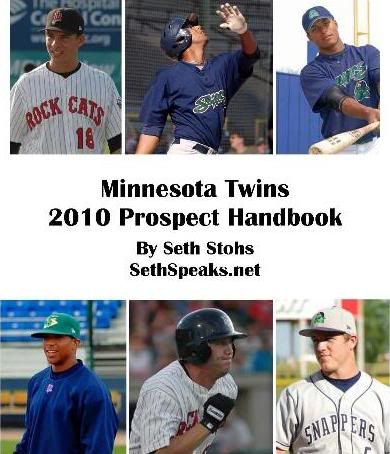
Minnesota Twins 2010 Prospect Handbook

And if you're interested in learning more about Twins prospects, I cannot recommend this next item enough. Seth Stohs wrote his first Minnesota Twins Prospect Handbook last year and it was a great first project. But much like the Twins Centric group, he continues to out-due himself from his last project and his Minnesota Twins 2010 Prospect Handbook is a must buy for anyone that has any interest in what is going on in the Twins farm system.

Whether you're a Minor League expert or don't know a single player, this handbook caters to everyone's knowledge. With over 123 pages of coverage and 150 prospect profiles, this handbook is chalked-full of premium Twins prospect coverage. Here's what you can expect from the handbook:

The Minnesota Twins 2010 Prospect Handbook is at the publisher. Now, it will still be two or three weeks before it will be available, but starting today, you can pre-order your copy(ies) of the book. The first 75 books pre-ordered will be signed by yours truly. You can see the book’s cover below. If you click on it (or Click here), you will be taken to a PayPal page where you can pre-order copies. The book will sell for $13.95, but if you pre-order in January (through Sunday), you can get your copy for the same price as last year’s book, $12.95.

Last year’s book had 81 pages. The 2010 Minnesota Twins Prospect Handbook has 123 pages. And this year… We’ve got some pictures! There are stories on:

· Foreword by Kelly Thesier

· Just over 150 Twins minor league profiles

o With more in-depth statistics and splits

o Scouting reports from several people in, around and outside the Twins organization

· Top 5 Prospects from the Twins DSL Team

· Twins as Players in the International Markets

· Twins in the AFL

· Interview with Jeff Manship: Big Leaguer

· Danny Valencia: On the Cusp

· 2009 Draft and Derek McCallum Q&A

· SethSpeaks Top 30 Twins Prospect lists, 2006-2010

· Top 10 Twins prospect lists from several minor league experts and some of your favorite Twins bloggers.

Of course, if you have any questions, I welcome them. Please e-mail me.


I recently asked Seth a few questions on the handbook, and here's what he said:
Josh's Thoughts: Tell us a little about the handbook.
Seth Stohs: I could write/talk about the Handbook for an hour. I am really excited about what it is going to be. I was proud of last year's book, and for a first book, I thought it was solid, but this year is so much more. Last year's was 81 pages. This year is about 123. There are over 150 player profiles that are much better than last year's. much more in terms of scouting reports and in terms of more in-depth statistics and splits. Also, this year, I've got articles about the Twins in the international markets, the Arizona Fall league, the 2009 draft with lots of quotes from draftees and a small Q&A with Derek McCallum, a Q&A with Jeff Manship, and a quote-filled article called On the Cusp: Danny Valencia, and more. And this year, I have my updated Top 30 Twins prospects, but also look back at my past five Top 30 lists which is always fun to see where I was right and where I was wrong. There are also Top 10 lists from some of the prospect experts like John Sickels, John Manuel and Kevin Goldstein, but also from several of your favorite Twins blogs. There is a very nice foreword by Kelly Thesier. And, I'm sure I"m leaving several things out.

Josh's Thoughts: How did you get the idea of writing the (original) handbook and what were some obstacles that you faced when writing it? Did you face any obstacles with the 2010 handbook?
Seth Stohs: One of the readers of my blog e-mailed me one day after the 2008 season and said that there has to be ways to make money as a blogger. He presented a few ideas, one of which was a prospect handbook, since I already had profiles for my Top 50. The obstacles can be things like following the transactions throughout the offseason. Finding time to write when you have a regular 8-5 job, a 3 year old, a blog, writing a TwinsCentric publication, is not easy and there were a lot of nights falling asleep at the computer at 2:00 a.m. and getting up to start over. Finding sources for information that you can get good information from and trust can be tough too, but I'm happy with what I got. having Jonathan Mayo helping with some of the editing was a huge help too.
Josh's Thoughts: How long did it take to write?
Seth Stohs: The first book, I wrote the first draft in 2-3 weeks. This year's book took a lot longer, just because there was so much more information. Also, I intentionally wanted to make it available in late January or early February to make sure I could cover the Arizona Fall League, the 40 man roster changes, spring training invites and any other transactions that occur in a typical offseason. So this year, it took from October until a week ago.

Josh's Thoughts: Will the book be available in any other formats (e-book, etc.)? And how do you feel seeing your name printed on something? (...I know a little off, but I always think it's pretty surreal to see something that you did printed and want to know if I'm just crazy or if everyone has that feeling. Ha!)
Seth Stohs: This book really is best in print version. Something that will be different this year is that it will be available at many bookstores around the Twin Cities and other places in the upper midwest. It will be available online. I'll be honest, to see my name on the cover of a book was pretty cool last year. The cover was simple, but still kind of cool. This year, the cover actually has six prospects on it, and my name. It looks more professional, and it's even more exciting.

Josh's Thoughts: Finally, what got you interested in following Minor League Baseball in the first place?
Seth Stohs: Well, going back to when I was eight years old and collecting baseball cards, I always gravitated to the prospect cards, the Rated Rookies, the Future Stars, the draft pick cards. I collected Beckett Focus on the Future Stars while it existed. Once I started blogging in 2003, I wanted a blog that I would enjoy. Once I realized how much minor league information was online, I founda niche. The Twins have always built from within and always were calling up players. The core of the current team came up through the system. I guess I just enjoy following the path from the draft or signing to the big leagues because there is no 'normal' path to the big leagues. It has been very interesting to see the increased readership and e-mail and comments on my site over the years relative to the minor leagues.

Everyone knows that Seth writes at his blog Seth Speaks on an everyday basis and strongly emphasizes the Minor Leagues. When I originally wanted to get into writing, I started reading both Seth Stohs and Jonathan Mayo (among several others) on a regular basis. Since I've been a baseball fan, I've always been very interested in the Minor Leagues and both of these guys covered them to a great extent. I can honestly say that without Seth's guidance, I probably wouldn't be writing Josh's Thoughts. And if I were, it'd be much, much worse (scary, I know).

Top 50 Twins Prospects 2010: #15 Tyler Robertson

2010 Top 50 Twins Prospects | #15 | Tyler Robertson

Position | Pitcher

Bats/Throws | Left/Left

Born | December 23, 1987 (Simi Valley, California)

School
| Bella Vista High School

Height
| 6'5''

Weight
| 220 lbs.

2009 Ranking | 10


Breakdown
Tyler Robertson was taken by the Twins in the third round of the 2006 draft. Despite having the potential to play college football, the Twins made Robertson's decision to play professional baseball easy with a $405,500 signing bonus. According to Rivals.com, Robertson received "medium" interest from schools like California, Nebraska and UCLA to play quarterback.

After signing quickly, Robertson threw 48 2/3 innings for the GCL Twins in 2006 and put up a a 4-2 record and 4.25 ERA in 11 appearances (10 starts). Instead of sticking with their status quo and letting Robertson go the Appalachian League in 2007, an injury forced the Twins to call-up Robertson to the Midwest League in late May. As a 19-year-old, he appeared in 18 games for the Snappers, winning nine. He would've finished second in the Midwest League with a 2.29 ERA but fell just short of qualifying. Robertson quickly jumped to the top of the prospect rankings, appearing as the #1 prospect on Seth Stohs' post-season Top 50 Twins Prospect list. He moved up to the Florida State League in 2008 and continued to dominate his opposition with a 2.72 ERA in 15 starts. Unfortunately, he developed shoulder tendinitis and was shut down in July. He came back healthy in 2009 but certainly wasn't as dominant as he was in the first-half of the 2008 season. Robertson was back in Ft. Myers, which was the best choice and he threw 143 1/3 innings, 41 innings more than his previous career high, with the Miracle. He had an 8-8 record and a 3.33 ERA in 26 starts.

Robertson is a built more like a quarterback than a pitcher, which probably doesn't mean a lot to most people, but when I see him throw, I can't stop thinking of him a throwing football instead of a baseball. His delivery is very unorthodox, albeit downright painful to watch and could result in many arm problems in the future. He has a very projectable body, but he's lost about five mph from his fastball since high school. Baseball America ranked Robertson as having the best curveball in the Twins system, but it's not his only 'plus' pitch. Robertson also has a good change-up and slider that he has also improved in recent years and is comfortable with throwing any pitch he has in his repertoire at anytime. He's been a starter up to this point in his career, but I've began to wonder if the Twins will try to protect his arm from any further injuries by moving him to the bullpen.

2009 Statistics
          Level      W     L     ERA      IP     K    BB     WHIP     FIP
          A+         8     6    3.33   143.1   103    51     1.32    3.10

2010 Outlook

Robertson will spend the entire season in Double-A New Britain in 2010. Depending on the amount of arms the Rock Cats have, he may be a candidate for the bullpen if their rotation is full.

Pitching Repertoire
  • Fastball (86-90)
  • Curveball
  • Slider
  • Change-up
Video


Estimated Time of Arrival
2012

February 13, 2010

Top 50 Twins Prospects 2010: #16 Deolis Guerra

2010 Top 50 Twins Prospects | #16 | Deolis Guerra

Position | Pitcher

Bats/Throws | Right/Right

Born | April 17, 1989 (San Felix, Venezuela)

School
| Not Available

Height
| 6'5''

Weight
| 200 lbs.

2009 Ranking | 12


Breakdown
Deolis Guerra received a $700,000 signing bonus from the New York Mets in 2005 as a 16-year-old. He got started in the states in 2006 as a 17-year-old. The Mets let him skip rookie ball and started to move him right up the later where he appeared in 17 games for the Single-A Hagerstown Suns. He had a 2.20 ERA with the Suns and the Mets felt comfortable with promoting him late in August and allow him to pitch for the St. Lucie Mets who would later win the Florida State League Championship. In 2007, Guerra found himself as an 18-year-old pitching in the Florida State League where he respectfully posted a 4.02 ERA in 21 appearances (20 starts). Despite his poor record of 2-6, everything seemed to be going right for Guerra.

In January of 2008, Guerra was traded along with Carlos Gomez, Philip Humber and Kevin Mulvey to the Twins for Johan Santana. The Twins weren't going to promote Guerra just yet, instead they wanted to see him prove that he deserved a promotion fromthe Florida State League. 2008, at the young age of 19, Guerra went 11-9 with a 5.47 ERA with the Fort Myers Miracle, a considerable regression from the year before. He began the 2009 season in the Florida State League and after 16 appearances (15 starts), Guerra was finally promoted to Double-A New Britain. Prior to the promotion, Guerra was 6-8 with a 4.69 ERA which is clear evidence that he still wasn't where the Twins wanted him to be, but they felt that a change of scenery was necessary for Guerra. He finished the season by winning six games for the Rock Cats and posting a 5.17 ERA.

Two-years later, Guerra is the only player still with the Twins from the Santana trade. It's hard to believe that he will only be 21-years-old in 2010 and that if he began his career with the Twins he'd likely be getting his first crack at the Florida State League. He has a very long delivery, which many believe is the source for his lack of velocity. Baseball America considers Guerra's change-up to be the best in the system. He also has a curveball, but it's far behind both his fastball and change-up. There's no reason to give up on Guerra yet, but it'd be nice to see some productivity from him this season.

2009 Statistics
          Level      W     L     ERA     IP     K     BB     WHIP     FIP
          A+         6     8    4.69   86.1    54     25     1.39    3.83
AA 6 3 5.17 62.2 49 17 1.26 3.52

2010 Outlook

Guerra will begin the 2010 season at Double-A New Britain and at just 21-years-old, he'll likely end the season there too.

Pitching Repertoire
  • Fastball (87-91)
  • Curveball
  • Change-up
Video


Estimated Time of Arrival
2012

February 12, 2010

Nick Punto Day

A few weeks back, Twins blogger Andrew Kneeland (of Twins Target) sent out an e-mail to different Twins bloggers asking to partake in Nick Punto Day. What is Nick Punto Day? Well, NPD isn't a holiday - at least not yet - but it is a day for Twins bloggers to give their thoughts on one of the most controvertible players in Twins history, Nick Punto.

We all hate when manager Ron Gardenhire describes him as a "gamer" or talks about his "hustle" and his yearning for Punto has even brought on several tasteful (and tasteless) jokes over the years, but I see why Gardenhire is so fond of him. Other than the fact that he's both over-payed and overplayed, he's a valuable player to have on a team.

Although he's only 5'9'' and 170 lbs., Punto is one of the most athletic players on the team. Every position he plays, he plays it well. Other than the 52 innings he's spent in the outfield, Punto has been used as an infielder throughout his entire career. At 32, he has racked-up over 5,300 innings at second base, shortstop and third base. And what's the most impressive about those 5,300+ innings is that his UZR/150 at each position has been great. At second base, his URZ/150 at second base is 3.9, at shortstop it's 18.1, and at third base it's 19.9.

With both J.J. Hardy and Orlando Hudson now in the fold, Punto is likely to receive a bulk of the starts at third base, which is his best defensive position. Danny Valencia, a top prospect in the Twins system, could be ready around mid-2010, which could push Punto into the role most would like to see him in, which is utility.

Punto has started an average of 125 games over the last five years and in the same span, he has hit .249/.324/.327 in 2,022 at-bats. Other than drawing a fair number of walks, Punto doesn't offer much offensively.

With all things considered, it's time to get down to the nitty-gritty...

I've grown tired and weary of the people that complain about Punto being penciled into the starting lineup. Punto, much like former Twins outfielder Carlos Gomez, should play everyday. Despite putting up atrocious numbers at the plate, both players can still be very valuable to a team with their great defense. The problem is that when your lineup already has two or three guys that aren't adequate on either side of the ball, then someone gets singled out.

Punto has wrongfully been the scapegoat to many complainers over the years. His defensive value cannot be denied. I've always thought that if Punto's to be blamed, then the front office is even more at fault. Gardenhire plays the roster he's given and knows Punto's value and believes that he offers something more than whatever else he has on the roster. And I agree 100% with him on that.

With guys like Hudson and Hardy filling out the middle infield, why not take a chance on Punto in the #9 hole? His defense is great at third base and great offensive production probably won't be a necessity.

Overall, I like Punto and hope he stays with the Twins. I do hope however that if the Twins do need more offense that Gardenhire doesn't think twice about pulling him out of the lineup.